“Conflict at one level is health at another…” 17:22
I like the notion that to understand the nature of conflict as essential to balance is to understand the context of which ecological systems (or world) operate. Us included. The analogy of lettuces was quite cheeky at 15:00 🙂
How do we create a marketplace that will pay landowners and others to double the carbon content of their soil?
Think of all the good things that would happen if the carbon content of the world’s soils were doubled from 1% to 2%, or from 2% to 4%. Think of the abundance that would happen as a result. Consider the amount of food that could be produced on the same stretch of land, or how much water could be stored in the soil. Think about no-till and organic cover-cropping and the amount of life that would be present in the soil if we let mycorrhizal fungi do their thing. Think about all the nutrients that would be available once more to plants and animals and us as a consequence of doubled carbon.
Think about the above-ground wildlife that would benefit from a vibrant, diverse, and abundant below-ground ecosystem. Think about…
I am loving this little handbook, The Climate Conscious Gardener, published by Brooklyn Botanic Garden. Why? They talk about permaculture and forest gardening as tools to mitigate climate change using each and every yard!!! Each contributor has a combo of accomplishments such as publications, research and of course, gardening.
Forest gardens are more prevalent than ever before. If you want more information on edible forest gardens, you can simply google it. Message me if you want more information 🙂
I think this article did a great job laying out the distribution of income streams for some of the “famous” permaculture farms and how long it took to develop to that level.
“A forest planted by humans, then left to nature’s own devices, typically takes at least 100 years to mature. But what if we could make the process happen ten times faster? In this short talk, eco-entrepreneur (and TED Fellow) Shubhendu Sharma explains how to create a mini-forest ecosystem anywhere.”
Check out these stunning 3D-printed sculptures that come to life when a strobe light is perfectly matched to their speed of rotation.
Sculptures created by John Edmark, an inventor, designer and artist who teaches design at Stanford University in California.
I am enthralled by this video because as the nature-enthusiast that I am, I know that fibonacci numbers are a sequence of number patterns found amongst vitally all organisms we know of. The Fibonacci numbers relate to the development of each living or once-living thing. You may have seen these unique spiral patterns in an ammonite fossil, a pinecone, the center of a sunflower, the proportions of the human body! A world that is seemingly random has some mathematical order.
Lets get down to it. Here is a recipe for a HEARTY and peculiar vegan soup that is crazy-delicious. Easily adaptable into an omnivorous dish. Accompanies virtually any other foods that compliment garlic. Potatoes, rice, pot roast, salads, you name it.
Behold! 50+ clove Creamy Roasted Garlic Soup! So good. So good.
With the help of my good friend, Jenan, we produced a vegan wonder soup out from the recipe below so I could rejoice in culinary splendor with her and my other vegan friends: http://www.healthandlovepage.com/magical-healing-soup-recipe/
When I cannot get a hold of prime pasture-raised meat, I eat a vegetarian diet anyhow. Not a stretch for me.
Here is what you need for 3-4 servings:
Blender of some kind, sharp knife, medium-large pot, stirring utensil, muffin tin and/or aluminum foil for garlic roasting.
5 heads of garlic
2 large onions
16oz veggie broth (or chicken stock would taste good)
4 T olive oil, approximately
Salt and Pepper to taste, parsley or sprig of fresh thyme if you’re fancy like that
1c cashew sour cream (or the real sour cream if you prefer):
2/3 cup cashews
1tsp apple cider vinegar
1/3C water, approximately
With your favorite sharp kitchen knife, slice the tops off the heads of garlic. Place each head cut-side down in it’s own compartment of a muffin tin. Drizzle with olive oil and cover the muffin tin with aluminum foil. Roast at 400°F for at least 30min or until the garlic cloves are extremely mushy. Or roast the garlic however you like. I don’t care. That’s just how I did it. If they’re lightly browned, that is perfectly okay and will add more roasted garlic flavor to your soup. Once the cloves are mushy, remove from oven and allow to cool.
Meanwhile, dice the two onions and add to your pot. Add 2T olive oil and sauté until golden brown. Set aside.
Making the cashew sour cream:
Combine cashews, apple cider vinegar and water and blend until smooth. If you have a blender like a Vitamix or just as powerful, good for you! This will be a breeze. Otherwise, soak the cashews for an hour+ to aid in blending with food processors, immersion blenders or standard blenders.
Add cashew sour cream to the stock pot full of onions. Add broth. Add the roasted garlic cloves. Decant leftover oil from roasting the garlic into the pot as well. Let’s not waste!
Did you bother cleaning out your blender or food processor from the cashew sour cream? If you did, well that was silly. You will need to blend the soup again.
Blend the soup until creamy. Put blended soup back into the pot and warm up. Add pepper to taste. I did not add extra salt. The broth contributed enough salt. Garnish with crushed cashews, avocado, sour cream, olive oil bits of roasted garlic, thyme. Get artsy. Enjoy! This soup rocks!
Each new native plant I learn about, I tend to find that is has therapeutic properties of some kind. This kept happening and then it hit me. My suburban yard is full of natural “pharmaceuticals”! Dandelion for my liver cleansing and a coffee substitute. Stinging nettle for hair tonics and vitamin-rich teas. Jerusalem artichoke tubers for fresh food during the winter. Mints and herbs for digestion and flavors for my meals. Red raspberry leaves for magnesium-rich tea. Birch sap for an energizing and hydrating tonic. From virtually every plant in my yard, I could find a nourishing use for. This felt empowering.
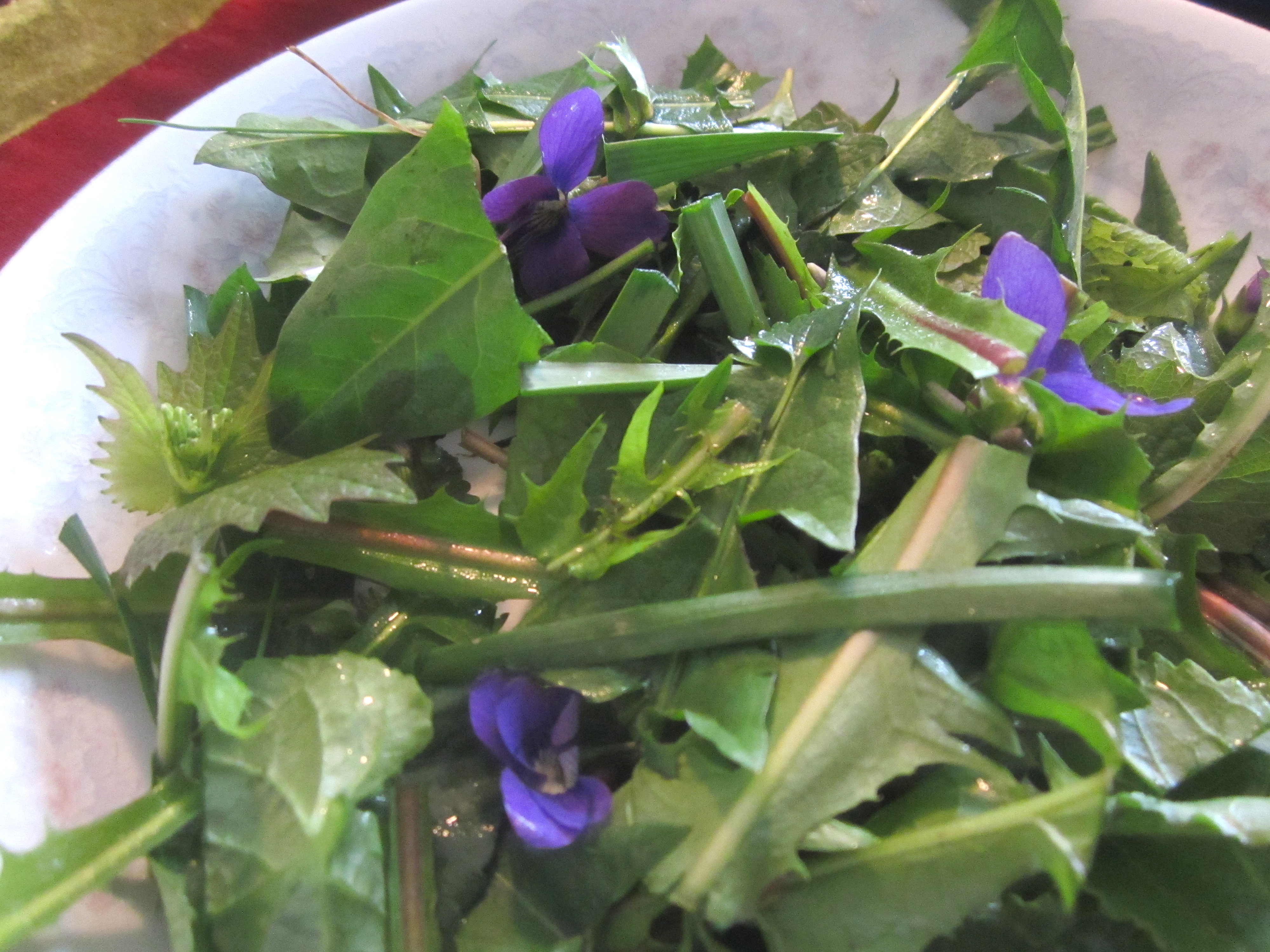
My wild backyard salad is safe and healthy to eat, but contains many native plants common in the Midwest with potent medicinal qualities.
I then looked around my neighborhood and was overwhelmed by the potential for their yards to do the same. They could be the face of the new ecological balance: distinct human habitats for restoration of food, medicine, fuel, the environment and community. But instead, these yards seem more like a reflection of their egos, battlefields where people control what can and cannot grow there; places where appearance takes precedence to ecological understanding.
The more I learned about the surrounding ecology, the more it felt as if the world is able to take care of our needs, so long as we know how to listen. I feel that we best take lessons from the Native Americans who were experts in this arena. Across millennia, their collective experiences regarding the therapeutic consumption of these plants should be listened to. Current westernized medicine cannot compare to thousands of years of this knowledge, but it can possibly be a tool to build more understanding of the value in many of these plants as well as Native American herbal remedies the plants were used for. Although I am skeptical of the testing methods that isolate a compound from a plant and rigorously test it. That takes away from the fact there are 100s-1000s of phytochemical interactions at work here that cannot be replicated in a laboratory setting. I regress…


 Green Karen LLC